Connect the sources
Bring records from separate programs into a common model while preserving their original status and business context.
I connect separate assurance programs into a shared view of evidence, owners, and the next responsible action.
Owners can see what to prepare. Reviewers can see what awaits acceptance. Leaders can trace a portfolio total to the dependency behind it. Keeping submitted and accepted evidence separate makes those handoffs visible.
Assurance Navigator public demo · 805 synthetic requests. The private Bedrock/Claude workbench and separate Claude Code evidence review are described below.
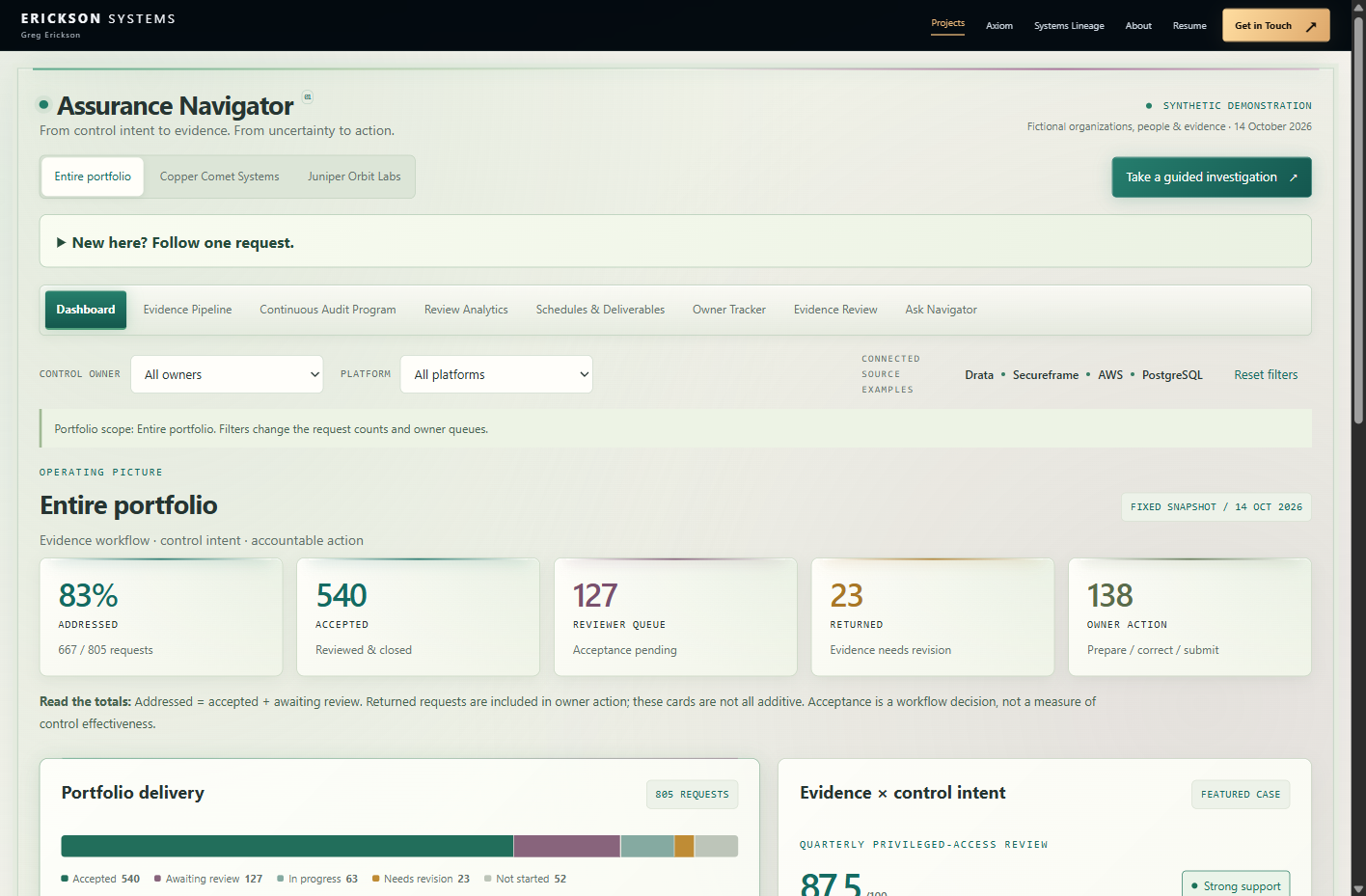
I built Vanta and Hyperproof API integrations, individual program dashboards, and a combined enterprise view. Snowflake data work, Jira, and Salesforce connections supported the broader operating picture.
Bring records from separate programs into a common model while preserving their original status and business context.
Keep submitted evidence separate from acceptance. Returned, in-progress, and unstarted requests remain visible as owner work.
Connect counts to owners, deadlines, exceptions, and review queues so a status can lead to a responsible next step.
The design decision: report workflow states separately instead of flattening them into a single completion number. Workflow progress still does not establish control effectiveness.

The public application uses 805 fictional requests across 12 platforms. Its views use the same request set, so you can inspect how a count relates to a particular owner and record.
Fully synthetic public example. The prepared investigation has fictional artifacts and analyst decisions. These records do not establish production outcomes or live integrations.
I developed an AI workbench using AWS Bedrock and Claude, semantic retrieval, and persistent context. It brings evidence and requirement context together so potential gaps can be investigated against their sources.
The workbench is a separate implementation. Its broader code and evidence are available for discussion through a walkthrough request; they are not the synthetic Navigator application.
Request a workbench walkthroughIn one review, 143 evidence rows were compared with 212 PCI DSS 4.0.1 requirements, producing 50 potential coverage-gap flags.
Those figures describe that review, not workbench performance. Its source evidence is not published here.
A flag is a lead for investigation. A reviewer must examine the requirement, scope, and original evidence before treating it as a finding.
See how Control Intent frames that questionUseful inputs include the source system, status, owner, time, scope, and relevant requirement. Missing or conflicting records should remain visible, with human judgment explicit.
Axiom implements retained memory and weighted context outside a single AI connection. Its completed private migration is described separately; the broader combined architecture is a development direction.
Explore the Axiom researchI built and completed a local embedding replacement after losing access to the earlier cloud embedding service. Record identities and source hashes stayed separate from the vectors used to find them, with a switch controlling which retrieval path production would use.
The corrected migration manifest defined these counts. They are verified manifest counts, not a claim that the full index had been completed or that retrieval quality had been proved.
Reconcile eligibility against the existing search rules before expanding what the system can retrieve.
Freeze the text/chunk recipe and use stable identities and hashes to make restart and correction inspectable.
Retaining records, generating vectors, retrieving the right evidence, and switching production are different tests.
Completed Axiom migration. I subsequently completed re-embedding and tested retained memory and weighting with a fresh Claude instance. The September 18 archive captures an earlier engineering stage. The completed result is my firsthand account; the figures above describe the earlier manifest.
Read the evidence and completion scopeI built source-linked signal ingestion and briefings around messages, meetings, work items, and evidence requests. The implementation carries source identifiers, timestamps, ownership, and unresolved actions forward so a reviewer can distinguish a handoff from unfinished owner work.
The context builder assembles a bounded startup pack from active work, organizational signals, and retained observations, with a manifest of what is included and left out. This is separate from query-time retrieval; either path can carry interpretations that still need verification.
These mechanisms support my work across owners, technical teams and reviewers: carry the source, identify the dependency, and make the next action explicit. Public examples use fictional people and records.
See how I collaborate